DRAFT SHELL for review. Copy and brand direction only. Images, video and blog are placeholders.

About

The Human Side of Process Improvement

Most improvement work fails at the people layer, six to twelve months in, long after the consultants have gone. Not because the process was wrong. Because nobody had the conversations the new process required.

That gap is the whole job.

Our Mission

Every organization has conversations that are not happening. Over time those avoided conversations do not disappear. They come back as friction, failed rollouts, retention problems, workarounds, quality issues, missed handoffs, and leadership blind spots.

GNS exists to find those conversations and start them, then leave behind a shared language so the next one is easier without us in the room.

Why we start early

Before the Elephant Gets Big

Nobody on your leadership team had this conversation when these questions were cheap and easy to ask. They are finding out mid career, after it's been expensive: the pivot, the burnout, the Porsche in the driveway.

So we do this work with schools, nonprofits and civic groups at cost. Not as charity, and not as a separate mission. Someone who learns at nineteen where their energy goes does not need a crisis to find out.

We equip people to take a moment and wonder, to pause. It's about stopping long enough to look, to understand an issue rather than driving around it. Learn it early and the elephant is still small. Never learn it, and your team is working around an elephant that has been growing for twenty years.

The conversation is the same. The elephant is just bigger.

Where Insight Meets Implementation

We don't run generic leadership programs. Every team, culture, and leader is different, so the work is built around what is actually stuck.

We start by finding where energy is going and where it is draining out. From there we design simple, repeatable ways for people to ask for help, hand work off, and disagree in the open without it costing anybody anything.

The instrument

What Working Genius Actually Is

The Six Types of Working Genius is a model developed by Patrick Lencioni and The Table Group. It is not a personality test. What it measures is how people contribute to getting work done, and where that work drains them.

Every person has two areas of Genius where they thrive, two of Competency where they can contribute but tire over time, and two of Frustration where they are least effective. Those six types run in order, and work moves through all of them.

W

Wonder

Asking why things are the way they are. Wonder notices that something could be better before anyone has named what.

I

Invention

Generating original ideas and solutions. Invention turns the question into something you can actually try.

D

Discernment

Judging which ideas will work, using instinct and pattern recognition. Discernment separates promising from impractical.

G

Galvanizing

Rallying people to act. Galvanizing builds the momentum that turns a good decision into movement.

E

Enablement

Supporting people and responding to what is needed, so the work keeps going once it starts.

T

Tenacity

Driving to completion. Tenacity pushes through obstacles and gets the thing finished to standard.

A frustration is not a weakness. It is a genius standing in the wrong intersection. The map on the homepage shows what that looks like on a real team.

Meet the Team

Founder · Collaboration Designer

Mitch Bliven

Mitch works on the human side of process improvement, the part that stalls a new leader, system, or rollout six to twelve months in. He picked up Lean and Six Sigma in construction, then data analytics, where he learned how systems run and why they fail at the people layer.

He builds for internal customers so they can support external customers, and Working Genius provides the data that makes it possible. As a Collaboration Designer, he brings to people systems the discipline Lean brought to the production line.

Husband, father, and systems nerd from Hudson, Wisconsin.

Chief Enablement Officer

Cassie Bliven

Cassie's leading genius is Enablement, which suits her well as an executive assistant and a natural networker. Even so, the initial integration wasn't easy.

Despite her natural gifts, things often fell flat. Mitch is a bit of a visionary, not the type of person Cassie naturally wants to work with. Instead of getting frustrated, she learned to back up, ask the why, and assess how to proceed.

Working Genius gave us the self-awareness to see it wasn't a lack of effort, it was a difference in wiring. Understanding each other's geniuses let us skip the blame game. That hasn't just made us better business partners, it has made us better parents who know how to ask each other for help.

How we show up

Our Own Map

This is the GNS team map. Same artifact a client receives, with our real data on it.
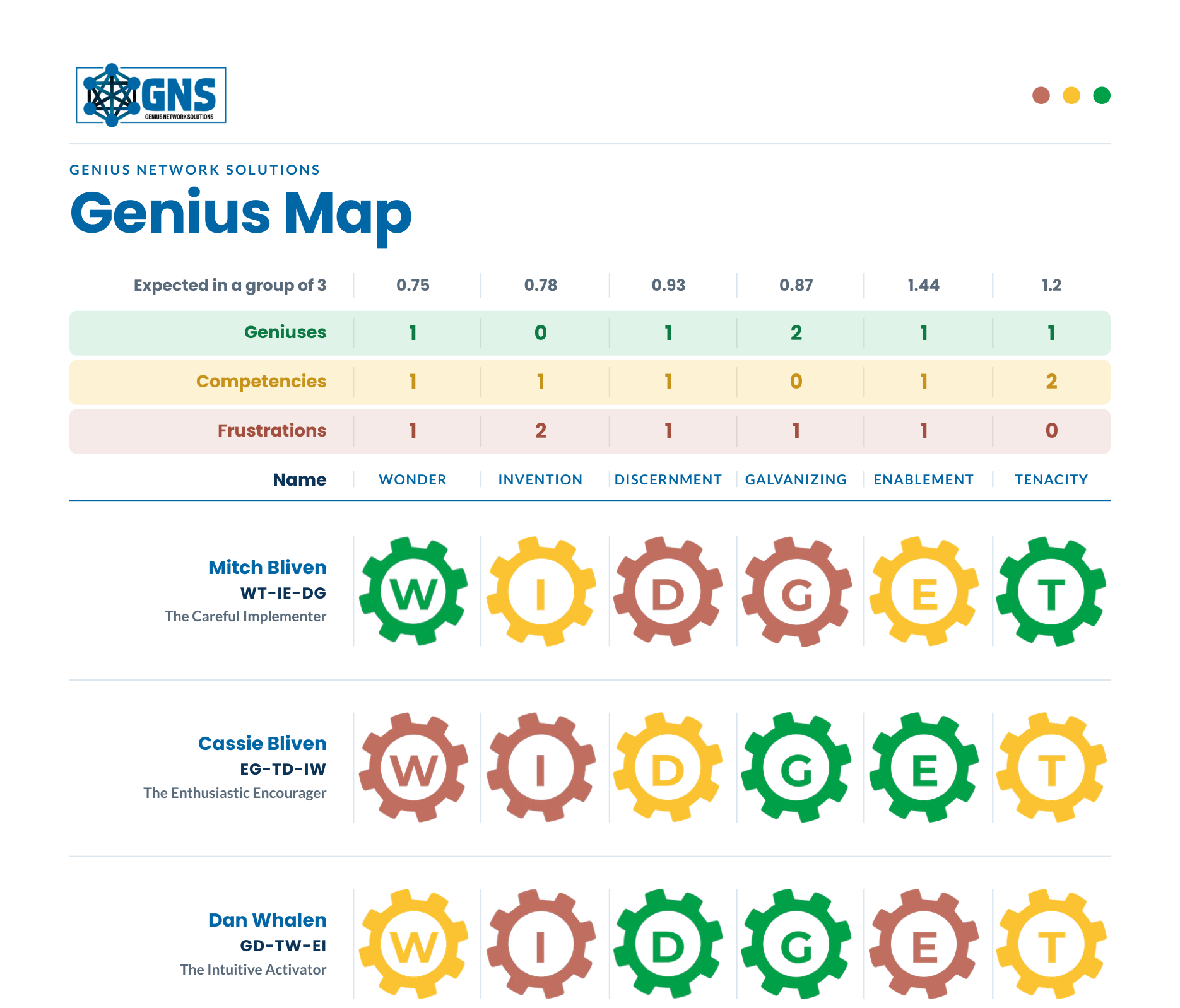
Green is go. Yellow is yield. Red is stop.
GNS Genius Map showing Mitch Bliven, Cassie Bliven and Dan Whalen with their six Working Genius gears coloured green, gold and dusty red.

Mitch tenaciously wonders. Wonder and Tenacity are his geniuses. Invention is his first competency. He learned that chasing his wonder is where he finds the most passion, creates the most value, and that is what made him an entrepreneur.

Galvanizing is his bottleneck. It is one of his frustrations, so rallying people to move on something drains him instead of feeding him. Ideas arrived. Then they sat.

Cassie relieved that bottleneck. Galvanizing and Enablement are her geniuses. She carries the scheduling and much of the data management, which is what frees Mitch to spend his time on the wonder (the thing she hates the most).

What was left was a bad connection, and it was not one person's gap. Look at the middle of the map. Discernment and Galvanizing are both frustrations for Mitch: deciding which idea is right, then getting people moving on it. Wonder and Invention are both frustrations for Cassie: asking the question, then building the answer. He sits on one side of that handoff, she sits on the other, and neither of us has so much as a competency reaching across it. The thinking and the doing never met in the middle.

That is what an integrator is for. Discernment and Galvanizing are Dan's geniuses, with Wonder as a competency. That makes him the one person on this map who reaches across that handoff. He picks up what Mitch is wondering about and turns it into a decision with an order behind it, which is exactly what Cassie needs in order to run.

None of these were easy conversations. They are not easy for anyone. Saying out loud, to the people you work with, that there is a part of your own business you are not built for, and then paying someone else to carry it, takes more humility than most teams can find. Bringing Dan in is one of the most valuable things we have done.

Then look at the Invention column. No geniuses, one competency, two frustrations, where a group of three would expect about one genius. Mitch covers it and it costs him.

Which is exactly why we work with fractional partners: ops leaders, HR leaders, subject matter experts. They bring a piece to the room we do not have, and pretending otherwise would cost the client. We map the people and start the conversation. The process design comes from someone whose genius is actually there.

What Clients Say

"Mitch is able to explain Working Genius in a really succinct and personal way. He reflected back to me what I already knew to be true: that helping and inspiring people is at the core of who I am, and that the closer I am to people, the happier I will be. I had never heard it framed that way before, and it couldn't ring more true."

Brianna Pyka, Google review

"What I appreciated most was his ability to create a comfortable conversation rather than simply review assessment results. He listened well, asked thoughtful questions, and helped me connect the findings to real situations in both work and life. Several months later, I still find myself reflecting on insights from our discussion."

Jason McBeth, Google review

Frequently Asked Questions

What is a Collaboration Designer?

Someone who resolves the friction on the human side of process improvement. When a new leader, system, or methodology arrives, the people aspects of collaboration are what derail it. That is the part Mitch works on.

Why Working Genius and not something else?

Because it measures the right thing. Most assessments describe who a person is. Working Genius measures where the work energizes them and where it drains them. That is the data that predicts what happens six months from now.

Who runs GNS?

Mitch Bliven, founder and Collaboration Designer. Cassie Bliven, Chief Enablement Officer, keeps every engagement organized and moving. Dan Whalen is our integrator.

Ready to Find Yours?

Thirty minutes, and it's the easy conversation.

Start The Conversation